
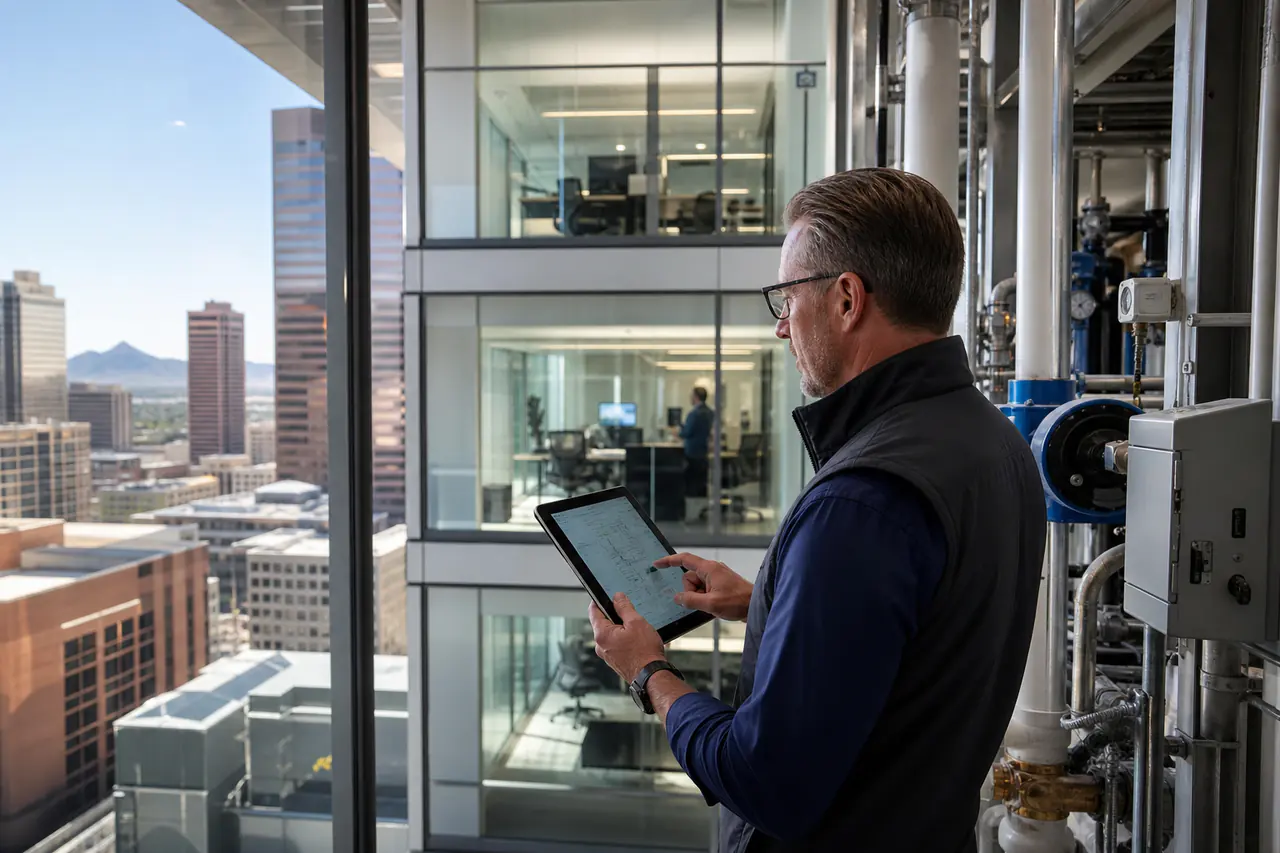
Phoenix, Arizona
Commercial Lighting Controls in Phoenix, AZ
- Occupancy sensing
- Daylight harvesting
- Scheduling
- Dimming
- Exterior & parking
- Retrofits
Local conditions
Phoenix has more usable daylight than almost any market in the country
The Valley averages around three hundred sunny days a year. That is an enormous amount of free light falling on perimeter zones, atriums, warehouses with skylights and parking structures — and in most Phoenix buildings, very little of it is being used to reduce electric lighting.
Daylight harvesting was often installed to satisfy the energy code and then never tuned. The photocell setpoints are at their factory defaults, the fade behaviour is abrupt enough that occupants notice and complain, and someone eventually put the zone into manual override. The equipment is there; the benefit is not.
The second Phoenix-specific factor is glare and heat. Aggressive daylight response without attention to blind position and solar angle produces spaces people find uncomfortable, which is how well-intentioned daylight zones end up permanently overridden. Commissioning against measured light levels in the actual space, at the times of day complaints occur, is what separates a daylight system that works from one that gets switched off.
Phoenix services
Lighting controls work in the Valley
- Lighting controls assessments on existing Phoenix facilities
- Occupancy and vacancy sensor coverage review and re-tuning
- Daylight harvesting commissioning against measured light levels
- Schedule matrix rebuilds after tenant or operating-hour changes
- Dimming and scene control programming
- Relay panel and contactor troubleshooting
- Exterior, parking-structure and site lighting control
- Astronomical scheduling for exterior zones
- High-bay and warehouse lighting controls
- Networked lighting controls programming and zone reconfiguration
- Retrofit of obsolete or undocumented lighting-control panels
- BAS integration where the lighting platform supports it
What we get called about
Common Phoenix lighting-controls problems
What you’re seeing
Exterior and parking lights run well past sunrise.
How we approach it
Astronomical schedules that were never set for this latitude, or a photocell that has degraded or been shaded by later construction. Both are quick to correct once identified.
What you’re seeing
Perimeter offices are uncomfortable when daylight dimming kicks in.
How we approach it
We re-commission photocell setpoints and fade rates against measured levels at the desk, not at the ceiling sensor, and coordinate with blind position where that is a factor.
What you’re seeing
Warehouse high-bay lighting stays on across an entire shift-less aisle.
How we approach it
Sensor coverage and grouping reviewed against actual traffic patterns. High-bay zones are frequently grouped far too coarsely to save anything.
What you’re seeing
Lights turn off on people in conference rooms.
How we approach it
Time delay, sensor technology and mounting location tested in the room under real conditions. Seated meetings defeat poorly placed PIR sensors constantly.
What you’re seeing
Schedules still reflect pre-renovation tenant hours.
How we approach it
Schedule matrix rebuilt against current occupancy including holidays and seasonal variation, then documented so the next change does not need us.
What you’re seeing
Nobody knows what platform the lighting panels are or how to change them.
How we approach it
We inventory the panels and devices, identify what is still supported, and produce the zone schedule and quick-reference guide that should have come with the building.
Whole-building
Lighting and HVAC schedules on one calendar
In Phoenix the two systems are more connected than they look. Lighting is a cooling load — every watt of electric light in a conditioned space becomes heat the HVAC system has to remove, and in a cooling-dominated climate that penalty runs most of the year rather than seasonally.
Cutting unnecessary lighting runtime reduces both the lighting bill and the cooling load it creates. Where the lighting platform exposes a usable interface, integrating it with the BAS means occupancy and after-hours behaviour are decided once, and the disagreement between two vendors’ calendars stops being a recurring source of complaints.

Questions
Frequently asked questions
Related capabilities
- Commercial Lighting ControlsFull lighting controls capability
- Building Automation PhoenixPhoenix BAS projects
- Building Automation Service PhoenixPhoenix controls service
- Energy ManagementRuntime and schedule optimization
- Controls CommissioningFunctional testing
- Arizona Service AreasCoverage across the state
Next step